
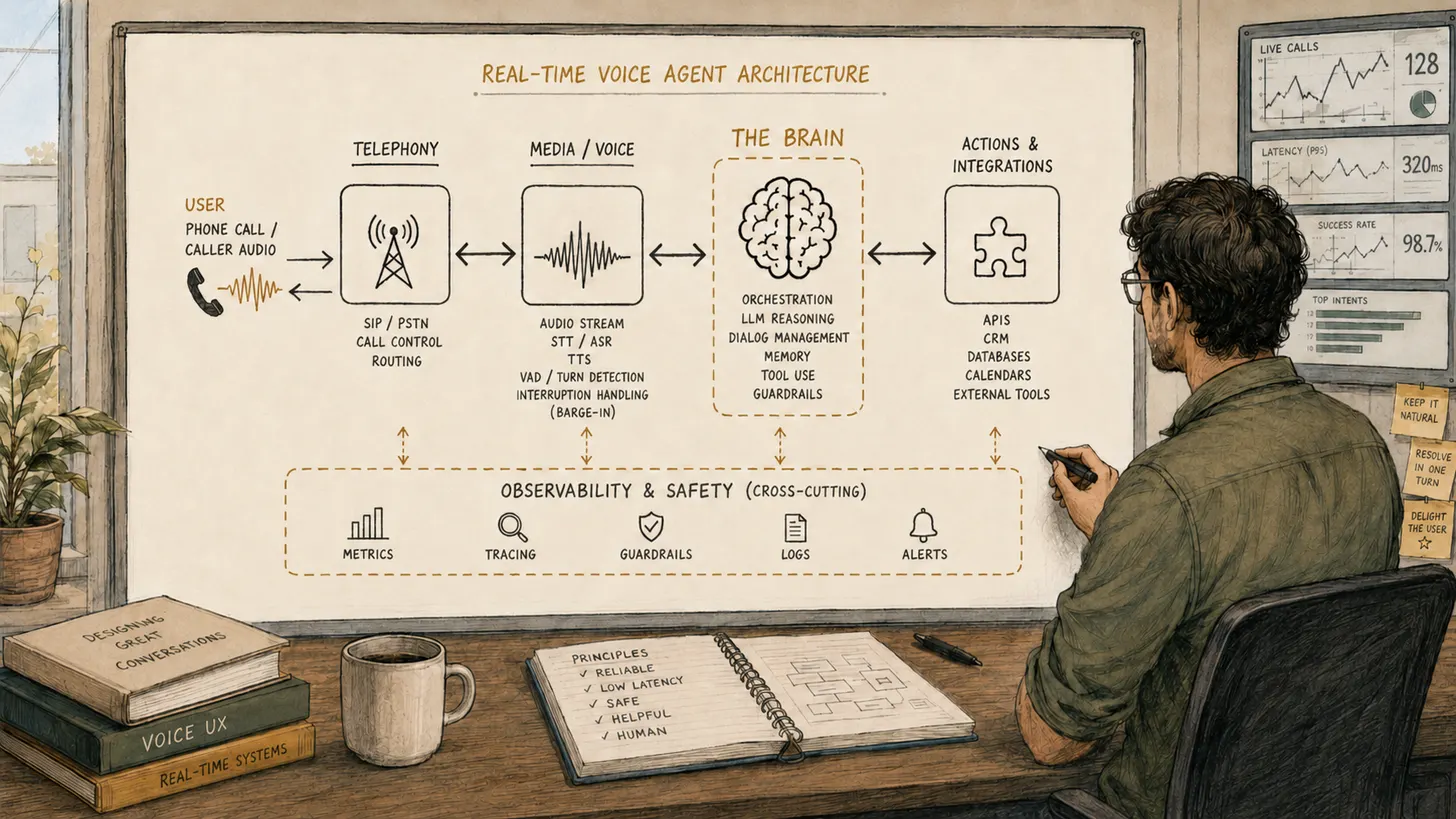
The caller says “I need to reset my PIN,” and then, half a second into the agent’s reply, they talk over it: “actually, it’s the account PIN, not the card.” A person handles this without thinking. A voice agent has to catch the interruption inside a few hundred milliseconds, stop talking, understand the correction, and keep going, all inside the roughly one-second budget a phone conversation allows before the silence feels wrong.
If you are building that agent on LangGraph, there is a tempting mistake waiting right here. LangGraph has a function called interrupt(). It is stable, first-class, and exactly the wrong tool for this moment. Understanding why is the fastest way to understand what LangGraph is actually for in a voice system, and what it is not.
This piece is about that boundary. LangGraph is a genuinely good choice for the stateful, branching, resumable brain of one voice agent. It is not the orchestrator for the whole real-time voice system, and treating it as if it were is how a clean demo turns into a call that talks over its own customers. The argument builds on why voice AI agents are harder than chatbots: a chatbot can wait, a voice agent cannot, and that single constraint decides which layer does which job.
What LangGraph is genuinely good at for voice
First, clear the stale impression. The open-source LangGraph framework reached its stable 1.0 release in October 2025 and is on a stable 1.x line with a no-breaking-changes-until-2.0 commitment. If your mental model is a churning pre-1.0 library, update it. This is production infrastructure now, used at that scale by companies like Uber, LinkedIn, and Klarna, per LangChain’s own account.
For a voice agent, the value is control flow and durability. A real call is not a single prompt and a single answer. It is a small state machine: authenticate, then branch on intent, gather the missing detail, call a backend, confirm, maybe hand off. LangGraph models that as an explicit graph of nodes and edges, so the flow is inspectable and testable rather than buried in prompt text. Its checkpointer-based persistence keeps the state of one conversation, keyed to a thread, so the agent remembers where it is in the flow, and a restarted process can pick up where it left off instead of dropping the call’s context.
And its streaming fits voice well. LangGraph offers several streaming modes, including a token-by-token messages mode that emits the model’s output as it is generated. That matters on a call, because you can begin feeding text to the speech synthesizer before the full reply exists, shaving the delay before the caller hears the first word. This is not a hypothetical: it is how the production voice integrations consume the graph, which we will get to.
So the strengths are real and current: explicit stateful logic, durable session memory, resumability, and early-streaming output. None of that is the part of a voice system that runs in hard real time.
The one-second turn, and where LangGraph sits in it
A voice turn has a budget, and it is unforgiving. From the moment the caller stops speaking to the moment they hear a response, you have roughly a second before the pause reads as broken. That budget is spent across several stages, and only one of them is LangGraph.
LangGraph is the reasoning step: given the current state and the caller’s words, decide the next action and start generating a response. Everything around it, capturing audio, deciding the caller has finished, transcribing, synthesizing speech, and detecting an interruption, runs in a layer LangGraph does not touch. Put the wrong work inside the graph and you spend budget you do not have.
The interrupt trap
Now back to the caller talking over the agent. LangGraph has an interrupt() function, and its name is a trap for anyone building voice.
Here is what interrupt() actually does. Called inside a node, it saves the current graph state through a checkpointer and, in the docs’ own words, “waits indefinitely until you resume execution.” When you resume, you pass in a value, the node restarts from its beginning, and execution continues. This is a beautiful primitive for durable human-in-the-loop: pause the agent so a person can review, modify, or approve, and come back to it minutes or even hours later with the state intact.
It is the wrong tool for barge-in, and not by a little. Barge-in is a sub-second audio event. The caller starts speaking, and within a few hundred milliseconds the system must stop its own speech and listen. interrupt() is a durable checkpoint that waits indefinitely and re-runs a node on resume. One is measured in milliseconds and lives in the audio path; the other is measured in seconds to hours and lives in the control flow. They share a word and nothing else.
| LangGraph interrupt() | Voice barge-in | |
|---|---|---|
| What triggers it | Your code, to pause for review or approval | The caller starts speaking over the agent |
| Who handles it | LangGraph control flow, via a checkpointer | The real-time media layer, in the audio path |
| Timescale | Seconds to hours; waits indefinitely | A few hundred milliseconds |
| What happens to state | Persisted to a checkpoint; node re-runs on resume | Playback stops; business state does not advance |
| Right use | Pause for a human to approve a refund or action | Let the caller correct or redirect mid-sentence |
One precision point worth keeping straight, because it trips people up: detecting that the caller has finished a turn (end-of-turn detection) and detecting that the caller has cut in over the agent (barge-in) are related but distinct mechanisms. Modern media orchestrators handle both, but they are not the same event, and neither of them is interrupt().
Compose it: the smallest piece for each pain
If LangGraph is only the brain, what is the rest of the system? This is where the discipline from when to use an agent framework pays off directly: adopt the smallest piece that solves each named pain, and keep your logic portable rather than marrying it to any one layer. A production voice agent is a small stack of layers, each earning its place.
The layers are not theoretical. LiveKit Agents provides an official LangGraph integration: you compile your graph and wrap it with an adapter that becomes the LLM node in the voice pipeline, and the adapter consumes LangGraph’s messages stream and forwards the tokens to text-to-speech in real time. That is the whole thesis in one API: the media framework owns the real-time loop, and LangGraph is the brain it calls. Pipecat fills the same media-orchestrator role with a focus on ultra-low latency over WebRTC, plus integrations across transports and telephony providers. Neither Pipecat nor LiveKit is a full telephony or CCaaS layer by itself: SIP and PSTN routing, contact-center policy, and enterprise telephony still live in the layer below them, which is why the stack keeps those separate.
For tool reach, the MCP adapters for LangChain turn Model Context Protocol tools into tools your graph can call, so the agent reaches identity, billing, and backend systems through a portable protocol rather than bespoke glue. When a single agent is not enough and you genuinely need specialist agents handing work to each other, that multi-agent coordination is its own layer, not something to force into one graph. And when you want the runtime concerns handled, a managed runtime like AWS Bedrock AgentCore hosts your compiled LangGraph graph and takes on scaling, session management, and identity. You still wrap the graph in the runtime’s entrypoint and validate session handling, identity, streaming, and observability against your own requirements; hosting is not the same as portability for free. LangChain also offers its own managed runtime for exactly this, LangSmith Deployment (formerly LangGraph Platform), purpose-built to run LangGraph graphs in production. Confirm the specific LangGraph support for whichever runtime you choose against its own current docs before you commit.
The scorecard is the rule stated plainly.
| The named pain | The layer that owns it |
|---|---|
| Sub-second barge-in, turn-taking, latency | Real-time media orchestrator (LiveKit Agents, Pipecat) |
| Stateful multi-step logic, branching, resumable session | LangGraph |
| Tool reach and portability | MCP (via the LangChain MCP adapters) |
| Multiple specialists handing off work | A dedicated multi-agent layer, only when needed |
| Runtime, scale, identity, observability | A managed runtime (e.g. AWS Bedrock AgentCore) |
Production risks and limits
The composition is right, but a few sharp edges are worth naming before they cut a live deployment.
Durability is only as good as your checkpointer. LangGraph’s “state persists automatically” is true, with a condition: it persists to whatever checkpointer you configure. Demo and quickstart examples often reach for InMemorySaver, which keeps checkpoints in RAM and loses them all when the process restarts, which is exactly when you needed the state. A production voice agent needs durable checkpointing instead: Postgres, SQLite for local development, or a managed persistence layer. Skip that and a mid-call restart drops the caller’s context.
Resume re-runs the node. When an interrupted run resumes, the node restarts from its beginning, so any code that ran before the pause runs again. If that code charged a card, sent a message, or fired a tool with a side effect, it fires twice unless you made it idempotent. On a call that touches billing, this is not a theoretical concern.
Barge-in is also a cancellation problem. Stopping playback is not enough. When the caller cuts in, the voice layer has to cancel or fence the active text-to-speech stream, ignore the stale model tokens still arriving from the turn the caller just abandoned, and make sure any tool calls from that interrupted turn cannot commit after the caller has changed direction. It is the same idempotency discipline as above, applied in real time: a half-finished turn must not leave a side effect behind.
Streaming is a dependency boundary. Not all of LangGraph’s streaming surface is equally settled. The token-by-token messages stream mode is stable and is what the voice integrations rely on, but the newer content-block event API (the version="v3" protocol for stream_events) is marked beta in the docs and may change. In a latency-sensitive voice path, pin your versions and test the exact streaming mode you depend on rather than betting the call on an interface that may shift under you. Re-check the streaming behavior you rely on at every upgrade.
Do not put the media path in the graph. The tempting anti-pattern is to make LangGraph orchestrate everything, including the audio. Every hop you add inside the reasoning graph spends milliseconds against a one-second budget. Keep the real-time media loop in the media layer, keep LangGraph as the brain it calls, and the budget stays yours to spend on the model, not on plumbing.
What LangGraph still does not solve
Composition is really a way of being honest about scope. Everything in the real-time path stays outside the graph, and it is worth naming that list plainly so none of it gets quietly assumed into LangGraph’s column:
- Endpointing and partial transcripts: deciding when the caller has actually finished a thought.
- Voice-activity detection and turn detection. LiveKit’s semantic turn detection, for instance, runs a transformer end-of-turn model alongside VAD, which is not the kind of work a control-flow graph does.
- The text-to-speech lifecycle: playback, and cancelling playback the instant the caller cuts in.
- Barge-in handling itself.
- Telephony routing, warm transfer, and escalation to a human.
- Compliance that lives in the audio path: PII, recording consent, and redaction.
- Voice-grade observability: ASR latency, model time-to-first-token, text-to-speech time-to-first-audio, tool latency, interruption recovery, containment, and resolution. This is agent observability with a real-time clock attached.
None of these are LangGraph shortcomings. They are simply not LangGraph’s job, and a production voice system has to own every one of them somewhere.
What to actually do
Use LangGraph for what it is genuinely good at: the stateful, branching, resumable brain of one voice agent, holding the durable session state for the call. Put real-time turn-taking and barge-in in the media layer, where LiveKit Agents or Pipecat already solve it. Reach your backends through MCP so your tools stay portable. Add a multi-agent layer only when you truly have multiple specialists, and host the compiled graph on a managed runtime when you want the scaling and identity handled for you.
Back to the caller resetting their PIN. When they talk over the agent, the media layer catches it and stops the speech, business state does not advance just because the caller interrupted (though the interruption itself is recorded in the trace), and the corrected intent flows back into the same LangGraph flow that was already running. Nobody called interrupt(). The call stays inside its second, because each layer did only its own job. That is the difference between a voice agent that demos and one that ships, and it is the same lesson that decides whether an IVA actually resolves the call or just deflects it. The architecture is the product.
If you are choosing the layers for a production voice agent, or trying to work out why one that sounded great in the demo keeps talking over its customers, that is the kind of scoping I do with teams. The full picture of the enterprise patterns is in Designing Enterprise Agentic AI Systems, and if you want a second set of eyes on a specific build, here is how I can help.
Frequently asked
Quick answers
- Is LangGraph good for building voice AI agents?
- Yes, for the part of the system it is designed for. The open-source LangGraph framework reached its stable 1.0 release in October 2025 and is on a stable 1.x line, so the older impression of it as a pre-1.0, unstable project is out of date. It is a strong fit for a voice agent stateful control flow: multi-step logic, explicit branching, durable session state keyed to a conversation, and resumability if a process restarts. What it is not is the real-time media layer. It does not run the speech-to-text and text-to-speech pipeline, detect end-of-turn, or handle a caller interrupting mid-sentence. Those belong to a real-time orchestrator such as LiveKit Agents or Pipecat. Used as the reasoning brain and composed with a media layer, LangGraph is a solid production choice; used as the whole system, it is the wrong shape.
- Can LangGraph handle real-time interruptions and barge-in on a voice call?
- Not by itself, and not through its interrupt() primitive. LangGraph interrupt() is built for durable human-in-the-loop: it saves the graph state through a checkpointer and, per the official docs, waits indefinitely until you resume execution. That is exactly right for pausing so a human can approve a refund, and exactly wrong for a caller who starts talking 300 milliseconds into the agent prompt. Barge-in is a sub-second, real-time event. It is handled in the media layer by the voice orchestrator: detecting that the caller has started speaking, stopping playback, and cutting the current text-to-speech output. LangGraph holds the durable session state through all of this; it does not do the real-time turn-taking.
- What is the difference between LangGraph interrupt() and voice barge-in?
- They operate on different timescales and solve different problems. interrupt() is a durable, asynchronous pause: it persists the exact graph state to a checkpointer and waits, potentially for minutes or hours, until a human or system resumes it, at which point the node re-runs from its start. Barge-in is a real-time, sub-second interruption of the audio: the caller talks over the agent, and the media pipeline must detect that immediately, stop the current speech output, and let the caller continue. One is a control-flow checkpoint measured in seconds to hours; the other is an audio event measured in milliseconds. Reaching for interrupt() to handle barge-in is the classic mistake, and it will not meet the latency the moment demands.
- How does LangGraph work with LiveKit or Pipecat for voice?
- The media orchestrator owns the real-time loop and calls LangGraph as the reasoning node inside it. LiveKit Agents provides an official integration: you compile your LangGraph StateGraph and wrap it with an LLM adapter, which becomes the LLM node in the voice pipeline. The adapter consumes the graph output using LangGraph messages streaming mode and forwards the token chunks straight to text-to-speech in real time, which minimizes time to first spoken word. Pipecat plays a similar media-layer role, orchestrating transports, telephony, and the speech pipeline over low-latency WebRTC or WebSocket. In both cases the division of labor is the same: the media framework handles audio, turn detection, and interruptions; LangGraph handles the decision logic and state.
- Do managed agent runtimes like AWS Bedrock AgentCore run LangGraph?
- AWS Bedrock AgentCore Runtime is framework-agnostic and hosts a compiled LangGraph graph rather than replacing it. The documented pattern is to compile your StateGraph, wrap it in an AgentCore application entrypoint that calls the graph on the incoming payload, and let the runtime serve it. AgentCore then handles the runtime concerns: scaling, session management, identity, and operational hosting, while your LangGraph logic runs inside it. You still wrap the graph in the runtime entrypoint and validate session handling, identity, streaming, and observability for your case, so this is hosting rather than portability for free. LangChain also offers its own managed runtime for this, LangSmith Deployment (formerly LangGraph Platform). Other cloud runtimes position themselves as framework-agnostic hosts as well, but confirm the specific LangGraph support for whichever runtime you choose against its own current documentation.
- What are the production risks of using LangGraph for a voice agent?
- Four to watch. First, persistence: LangGraph durable state is only as durable as the checkpointer you configure. The in-memory checkpointer that quickstarts use loses everything on restart, so production needs a durable backend such as Postgres. Second, resume and cancellation semantics: when an interrupted run resumes, the node restarts from the beginning, so any code that ran before the pause runs again and must be idempotent; and on a live call, a barge-in means you must cancel the abandoned turn so its stale tokens and tool calls cannot commit after the caller changes direction. Third, currency: LangGraph moves fast, and its newest content-block event-streaming protocol (the v3 stream_events API) is marked beta while the messages mode is stable, so pin your versions and re-check the streaming behavior you depend on. Fourth, architecture: putting the real-time media path inside the graph, the graph-owns-everything anti-pattern, adds hops you cannot afford against a roughly one-second turn budget. Keep the media layer separate.