
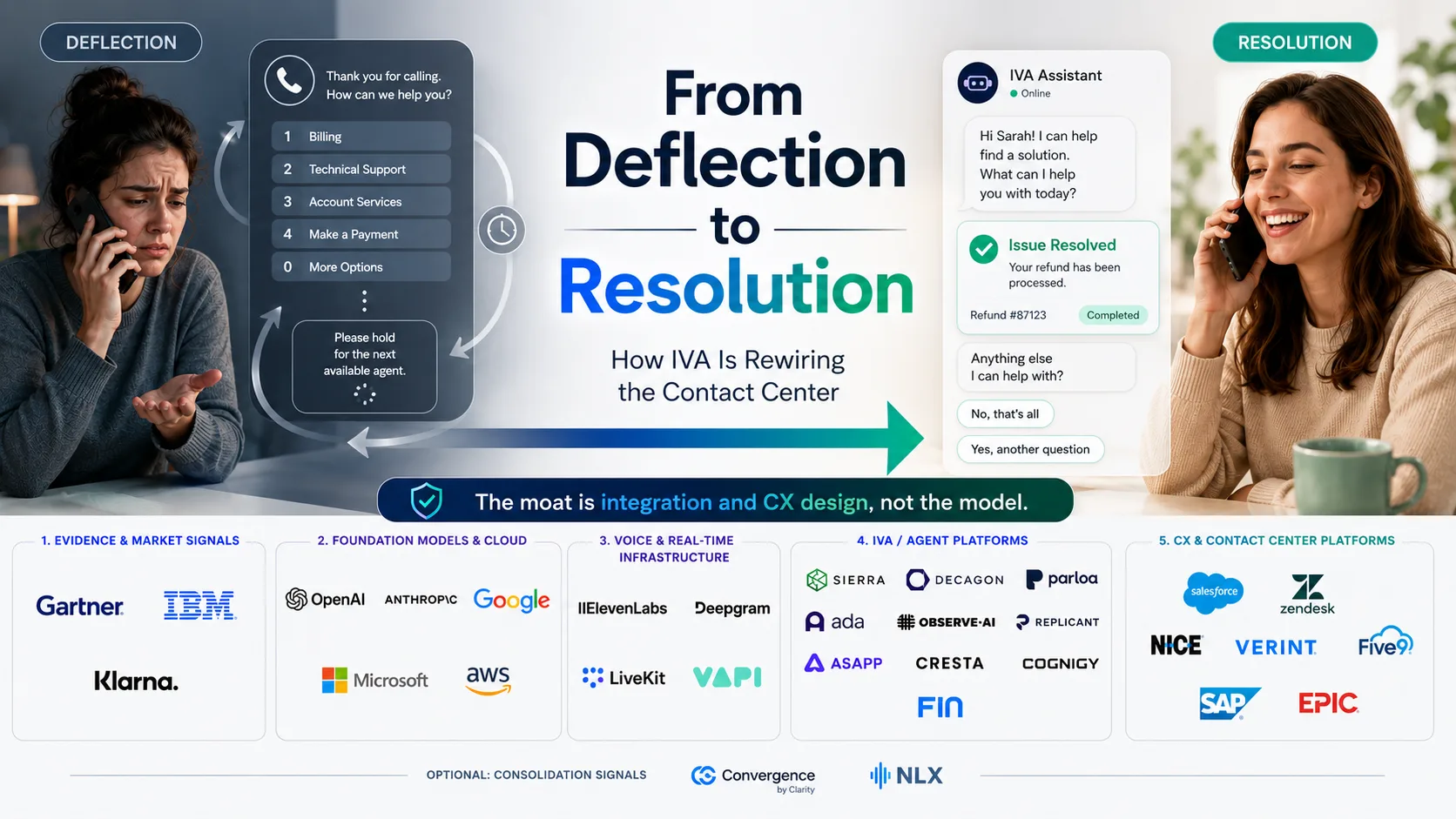
Most of the argument about AI in the contact center is aimed at the wrong target. The interesting question is not whether an AI can talk to a customer. It is what you are asking the AI to do. For three decades the job of the phone system was to keep callers away from agents. The interactive voice response menu, “press 1 for billing, press 2 for support,” existed to deflect, contain, and route at the lowest possible cost. Intelligent virtual agents are sold as the upgrade, and the marketing points at better speech and reasoning. The upgrade that actually matters is a change of goal: from deflecting the caller to resolving the call.
That single shift, from a deflection machine to a resolution system, is quietly re-pricing the entire market. It explains where the money went in 2026, it explains why a lot of that money will be disappointed, and it changes what a CX leader should measure and buy. Here is the through-line for everything below: the technology changed, but the thing that decides who wins is whether the buyer understood that the goal changed too.
The argument runs in four moves, mapped here before we work through each.
What the IVR was actually for
It helps to be honest about the old system before judging it. The IVR was not a failed attempt at customer service. It was a successful cost-control machine. Its job was containment: sort the caller, answer the trivial cases with a recording, and route everyone else into the cheapest available queue. The metrics that ran the contact center followed from that job: containment rate, average handle time, cost per contact. The goal was to spend as little human time as possible per interaction.
Under the constraints of the time, that was rational. The technology genuinely could not resolve much, so the sensible move was to triage and deflect. The lens was always cost. When Gartner predicted in 2022 that conversational AI would cut contact center agent labor costs by $80 billion by 2026, it was speaking the native language of that world: savings, headcount, deflection. The menu tree was a sorting machine, not a problem solver, and everyone knew it.
The flaw in that model is the one the industry then carried straight into the AI era: deflection counts a solved problem and an abandoned one exactly the same way. A caller who got an answer and a caller who gave up in frustration both register as “contained.” The metric never cared about resolution, because the system was never really built to resolve. That assumption is the thing IVA breaks.
Pillar 1: the metric moved from deflection to resolution
By 2025 the market language was clearly moving, from containment and labor savings toward autonomous resolution and customer effort. The clearest signal came from the same analyst house. In March 2025 Gartner predicted that agentic AI would autonomously resolve 80 percent of common customer service issues by 2029, cutting operational costs 30 percent, and framed the destination as “autonomous and low-effort customer experiences.” Read the two predictions back to back and the shift is unmistakable: from cost and labor deflection in 2022 to autonomous resolution and customer effort in 2025.
Talk is cheap, so look at pricing, which is not. The strongest evidence that the metric really moved is that vendors started charging for resolution. Zendesk introduced per-resolution pricing, billing roughly $1.50 per automated resolution, and the independent analyst firm IDC described the move as a shift toward resolution-centric customer service. Salesforce and Microsoft moved their agent products to consumption pricing tied to actions and outcomes rather than seats. A vendor moves toward per-resolution pricing when it wants buyers to believe the system can resolve, and when it is confident enough to tie at least part of the commercial model to outcomes. The business model moved from “we save you labor” to “we solve the problem,” and that is a more honest and more demanding promise.
For a CX leader the practical consequence is concrete: stop grading containment. A containment number tells you how many people stopped reaching you, not how many you helped. Grade resolution rate, grade customer effort, and grade the quality of the escalation when the agent cannot finish the job. If your dashboard still leads with deflection, you are running an IVA on an IVR scorecard.
Pillar 2: the line between self-service and a live agent is dissolving
The old contact center had a hard internal border. On one side sat the self-service tier, the IVR and the early chatbots, built to handle the cheap cases. On the other sat live agents, expensive and reserved for everything self-service could not contain. The handoff between the two was a cliff: the customer fell off the automated path, landed in a queue, and started over.
IVA collapses that border into a continuum. The same system can attempt a resolution, escalate with full context when it hits its limit, assist the human who takes over, and take the conversation back for routine follow-up. McKinsey’s customer-care research points in the same direction, estimating that generative AI could reduce human-serviced contacts by up to roughly half in sectors such as banking and telecommunications, depending on how automated a company already is, and describing the destination as an orchestrated system where AI resolves the routine matters while humans elevate the relationships that need them. The org chart of customer service, self-service versus agents, stops being two departments and becomes one graded flow.
But “the divide is collapsing” is not the same as “the human is disappearing,” and the most useful case study of 2025 is the one that proves it. In February 2024 Klarna and OpenAI announced that Klarna’s AI assistant had handled two-thirds of its customer service chats in its first month, doing the work of 700 full-time agents and cutting resolution time from eleven minutes to under two, with a claimed $40 million profit improvement. Those are company-reported figures, and they were spectacular. Then in May 2025 the same CEO said the company had cut too deep and was rehiring humans, warning that optimizing for cost over quality produces lower quality, and that customers must always be able to reach a person. The independent counterweight came from IBM, whose 2025 study of 2,000 CEOs found that only about a quarter of AI initiatives had delivered their expected return and only 16 percent had scaled across the enterprise.
The vendor resolution numbers tell the same story when you read them carefully. Intercom’s Fin agent was reported at roughly 67 percent average resolution in late 2025, with Fin’s own 2026 materials putting the figure closer to 76 percent, and Zendesk claims mature deployments reach into the 80s. All of these are company-reported, each vendor defines “resolution” on its own terms, and they hide enormous variance between a clean deployment and a messy one. The honest synthesis is the hybrid: AI takes the routine half, the human holds the complex, high-emotion, high-stakes remainder, and the handoff between them is not a failure path. It is the product.
Pillar 3: voice is the hard last mile
Text and chat conversational AI is more mature than voice, especially for bounded support journeys. Voice is where the value and the difficulty now concentrate, and the 2026 capital map shows it plainly. The money flooding voice infrastructure went there because it is the unsolved, high-value frontier: ElevenLabs raised $500 million at an $11 billion valuation in February 2026, Deepgram reached $1.3 billion in January 2026, LiveKit hit $1 billion in January 2026, and Vapi reached roughly $500 million in May 2026. Investors do not pay those multiples for a solved problem.
Voice is harder for a structural reason I have written about at length in why voice AI agents are harder than chatbots: a chatbot owns the clock and a voice agent does not. A voice agent runs against a hard latency budget of about a second across the whole pipeline, has to handle the caller interrupting it, gets a single imperfect pass at noisy speech it cannot take back, and has to integrate with telephony and transfer cleanly to a human. None of that exists on chat. This matters for the contact center specifically because the phone is still where the hardest, most emotional, highest-value interactions land. Replacing the IVR is the last mile of the shift, and it is the hardest mile precisely because it is voice.
Pillar 4: the moat is integration and CX design, not the model
Now read the rest of the 2026 funding map, because it carries the most important lesson and the easiest one to miss. The individual numbers matter less than the pattern: capital is moving toward two layers, full-stack resolution agents and the voice infrastructure underneath them. At one pole, a cluster of full-stack enterprise CX agents (Sierra, Decagon, Parloa, and the longer-standing Cresta) sits on billion-dollar valuations. At the other pole, the voice infrastructure repriced just as fast. The two charts here carry the figures, with sources in the notes. Several earlier contact-center AI names, including Ada, Observe.AI, Replicant, and ASAPP, appear to have last announced major priced rounds in the 2021 to 2022 cycle. That does not make them weak businesses, but it shows how investor attention has rotated toward full-stack agents and voice infrastructure.
Here is the operator’s caution, and it cuts against the headline valuations: the best-funded model does not win the contact center. Outcomes come from the unglamorous layer. They come from integration with the telephony and CTI stack, access to the CRM and the workflows that actually resolve a request, identity and permissions, and a handoff designed to carry context. Consider that LiveKit, the real-time transport that carries OpenAI’s voice product and Salesforce’s Agentforce voice, is a billion-dollar company precisely because it is plumbing. Consider that Parloa sells an agent management platform and leads with its integrations into SAP, Microsoft, Five9, and Epic. Consider that when Amazon’s Ring chose a voice vendor, it picked Vapi over more than forty rivals on operational fit, not on a benchmark score. Consider Cresta, which has built its position in real-time agent assist and conversation intelligence inside live contact-center workflows, competing on operational depth rather than a headline valuation: its last priced round was a $125 million Series D in late 2024, and it has stayed out of the 2026 mega-round race entirely. The value in every case is the integration surface, not the raw intelligence.
The clearest proof is what the incumbents did. 2025 was a consolidation year, and the platforms that own the customer relationship bought capability rather than trying to out-model the startups. NICE acquired the conversational AI vendor Cognigy for around $955 million, closing in September 2025. Thoma Bravo took the CX analytics incumbent Verint private for roughly $2 billion. Zendesk acquired Forethought, AWS acquired NLX, Salesforce acquired Convergence, and Deepgram acquired the drive-thru voice firm OfOne. The pattern only accelerated: in June 2026 Salesforce agreed to acquire Fin, the former Intercom, for about $3.6 billion, folding a mature autonomous customer-service agent (across chat, email, WhatsApp, SMS, phone, and Slack) into Agentforce. Platforms that own the customer relationship are buying resolution capability, workflow depth, and distribution-ready agents, not models. Meanwhile the incumbents’ own agent revenue grew fast on the strength of distribution: Salesforce reported Agentforce annual recurring revenue around $800 million, up 169 percent year over year in its fiscal 2026 results, and NICE reported AI and self-service ARR around $328 million, up 66 percent. The model layer, by contrast, is commoditizing: the same Anthropic and OpenAI frontier models are resold inside Google, Amazon, and Salesforce CX stacks even as each ships its own. When the intelligence is interchangeable, the moat is everything around it.
| Acquirer | Target | Deal |
|---|---|---|
| NICE | Cognigy | acquired · ~$955M · Sep 2025 |
| Thoma Bravo | Verint | took private · ~$2B · Nov 2025 |
| Zendesk | Forethought | acquired · Mar 2026 |
| AWS | NLX | acquired · Apr 2026 |
| Salesforce | Convergence | acquired · 2025 |
| Salesforce | Fin (ex-Intercom) | agreed to acquire · ~$3.6B · Jun 2026 |
| Deepgram | OfOne | acquired · Jan 2026 |
This is the same lesson as why most agentic AI demos fail in production, applied to a market instead of a system. A demo, or a funding round, proves the model can resolve a case once under good conditions. Production proves it resolves the case repeatedly, integrated into the real telephony, CRM, and permission boundaries of a live contact center, with a clean handoff when it cannot. The gap between those two is integration and CX design, and that gap is where the value, and the disappointment, actually live.
What this means if you are buying or building
If you take one thing from the shift, take a new scorecard. Four practical moves follow from it.
First, change what you ask vendors for. Demand resolution and customer-effort numbers measured on accounts that look like yours, not containment rates and not demo win rates. Treat any “autonomous resolution” figure as vendor-defined until it is proven on your own data, because every vendor draws the line around “resolved” differently. And hold the line on what resolution means: not that the agent ended the conversation, but that the customer’s issue was actually completed, confirmed by the customer, reflected in downstream system state, or borne out by the absence of a repeat contact.
Second, weight the integration over the model. The model is the easy, interchangeable part. Score vendors on how cleanly they connect to your telephony and CTI, your CRM and workflows, your identity and permissions, and how well they hand off to a human. A smaller vendor that integrates well will beat a better-funded model bolted on badly.
Third, design the handoff as a feature, not a failure. Klarna’s correction is the lesson: keep a human reachable, and make sure the AI carries context across the handoff so the customer never starts over. The continuum only works if the seam is invisible.
Fourth, start where the blast radius is low. Pick a high-volume, well-bounded, low-stakes use case first, the same logic as choosing what to automate first, so the inevitable early mistakes are cheap and you learn the integration before you bet the hard calls on it. This is the work I help teams scope and de-risk through a readiness review, and you can see how I can help if that is where you are. The deeper treatment of the controls, the architecture, and the failure handling sits in Designing Enterprise Agentic AI Systems.
Put together, that is a scorecard you can hand to a vendor or hold yourself to. It tracks outcomes, not activity:
| Legacy IVR | Modern IVA |
|---|---|
| Built to deflect | Built to resolve |
| Measures containment and cost | Measures resolution and customer effort |
| Routes callers through menus | Understands intent and attempts the task |
| Treats abandonment as containment | Separates true resolution from drop-off |
| Escalation often loses context | Escalation preserves context |
| Optimized for queue protection | Optimized for customer outcome |
Same callers, different goal. The IVR sorts and contains; the IVA resolves and escalates with context. The metric moves with the goal.
The goal changed, not just the technology
The IVR era asked one question: how do we keep this call away from a person as cheaply as possible. The IVA era asks a better one: how do we actually resolve this, and hand the rest to a person well. Everything that follows, the metrics worth tracking, the vendors worth buying, the funding that will pay off and the funding that will not, falls out of which question a company is really answering.
That is why the market is bifurcating into full-stack agents and the infrastructure under them, why the incumbents are buying integration rather than models, and why the same frontier model can sit inside a deployment that delights customers and one that infuriates them. The companies, and the buyers, who internalize that the goal changed are the ones who will get value from this wave. The rest will spend a great deal of money buying a very expensive deflection machine, and wonder why their customers still cannot get their problem solved.
Notes and sources
Figures are dated to when they were reported, and the market moves fast, so treat the funding numbers as a mid-2026 snapshot rather than a standing ranking. Where a number is a vendor’s own claim (resolution rates, ARR), it is flagged as such in the text, because vendors define “resolution” on their own terms.
- Gartner, August 2022: conversational AI to cut contact center agent labor costs by $80 billion by 2026.
- Gartner, March 2025: agentic AI to autonomously resolve 80 percent of common customer service issues by 2029.
- McKinsey: the contact center crossroads, finding the right mix of humans and AI.
- Klarna and OpenAI, February 2024: AI assistant handles two-thirds of customer service chats in its first month (company-reported).
- Bloomberg, May 2025: Klarna turns from AI back to human customer service.
- Fortune, May 2025: the Klarna reversal and IBM’s finding that only a quarter of AI projects hit their ROI.
- IBM Institute for Business Value, 2025: the CEO study on AI ROI and scaling.
- Salesforce, June 2026: definitive agreement to acquire Fin, formerly Intercom, for about $3.6 billion.
- Funding and valuations (selected, mid-2026): Sierra $950M at over $15B, May 2026; Decagon $4.5B, January 2026; Parloa $3B, January 2026; ElevenLabs $11B, February 2026; Deepgram $1.3B, January 2026; LiveKit $1B, January 2026; PolyAI $750M, December 2025; Vapi about $500M, May 2026. Cresta’s last priced round was a $125M Series D in late 2024; its valuation is inferred from its 2022 round and has not been disclosed since.
- Other acquisition figures are from public reporting (TechCrunch, Bloomberg, CNBC, and company releases) across 2024 to 2026.
Frequently asked
Quick answers
- What is the difference between IVR and IVA?
- IVR (interactive voice response) is the traditional phone menu: "press 1 for billing, press 2 for support." It is a routing and containment system built to sort callers and keep as many as possible away from a human agent at the lowest cost. IVA (intelligent virtual agent) is the AI-era successor: a conversational agent that can understand a free-form request and, in the better deployments, actually complete the task. The important difference is not the interface. It is the goal. IVR was measured on deflection and containment; IVA is, or should be, measured on resolution.
- Why is deflection or containment the wrong metric for AI customer service?
- Because deflection counts a solved problem and an abandoned one the same way. A high containment rate can mean your customers got help, or it can mean they gave up and stopped trying to reach you. The metric was a reasonable proxy in the old world, where the system genuinely could not resolve much and the goal was cost control. In the IVA era it actively misleads, because it rewards an agent that ends the conversation regardless of whether the customer's issue was actually fixed. The better scorecard is resolution rate, customer effort, and the quality of the escalation when the AI hands off.
- Can AI really resolve most customer service issues on its own?
- For routine, well-bounded issues, increasingly yes; for complex, high-emotion, or high-stakes ones, not reliably yet. Gartner predicted in March 2025 that agentic AI would autonomously resolve 80 percent of common customer service issues by 2029. McKinsey's independent estimate is that generative AI could reduce human-serviced contacts by up to roughly half in some sectors, depending on existing automation. Vendors report higher live numbers (Intercom cited a roughly 67 percent average resolution rate for its Fin agent in late 2025, with Fin's own 2026 materials putting it closer to 76 percent, and Zendesk claims mature deployments reach into the 80s), but those are company-reported and vendor-defined, and they vary widely by deployment. The honest read is that AI takes the routine half and the human holds the difficult remainder.
- Why is voice harder than chat for customer service AI?
- A chatbot owns the clock; a voice agent does not. On chat the agent can take a second or two to think, the customer can re-read the screen, and a wrong word is visible and correctable. On a live call none of that holds: there is a hard latency budget of about a second across the whole pipeline, the agent has to handle interruptions (barge-in), the input arrives as an imperfect transcription it cannot take back, and it has to integrate with telephony and transfer cleanly to a human. That is why voice is the last and hardest mile of the contact center, and why so much 2026 funding is going into voice infrastructure specifically.
- Which conversational AI companies are best funded in 2026?
- As of mid-2026, capital is concentrating at two poles. Full-stack enterprise CX agents: Sierra raised about $950 million in May 2026 at over $15 billion, Decagon reached a $4.5 billion valuation in January 2026, and Parloa hit $3 billion in January 2026. Voice infrastructure: ElevenLabs raised $500 million at $11 billion in February 2026, Deepgram reached $1.3 billion in January 2026, LiveKit hit $1 billion in January 2026, and Vapi reached roughly $500 million in May 2026. These figures age fast, so treat them as a snapshot of where conviction sat in 2026, not a permanent ranking.
- Does buying the best-funded AI vendor guarantee better customer experience?
- No. The model is the easy part and increasingly interchangeable; the same frontier models are resold inside competing stacks. What determines outcomes is the unglamorous layer: integration with your telephony and CRM, access to the workflows that actually resolve a request, identity and permissions, and a handoff to a human that carries context. That is why the 2025 to 2026 period was dominated by incumbents acquiring agent and voice capability rather than out-building it, and why a well-integrated, well-designed deployment from a smaller vendor often beats a better-funded model bolted on badly.