
An engineer wired up his own body as a sensor and turned it on his calendar. Using Claude (the Fable model), he reverse-engineered his WHOOP, pulled per-minute heart-rate data, matched the spikes against calendar events and attendees, and produced a leaderboard of which meetings, and by implication which coworkers, cost him the most beats per minute. (WHOOP is a wearable that tracks heart rate, heart rate variability, sleep, strain, and recovery: in plain terms, how your body is reacting through the day.) The post went past two million views, and most of the reaction was some mix of delight and dread.
It is funny. It is also, if you run a customer-facing operation, a quietly useful signal pointing at something most CX programs never look at.
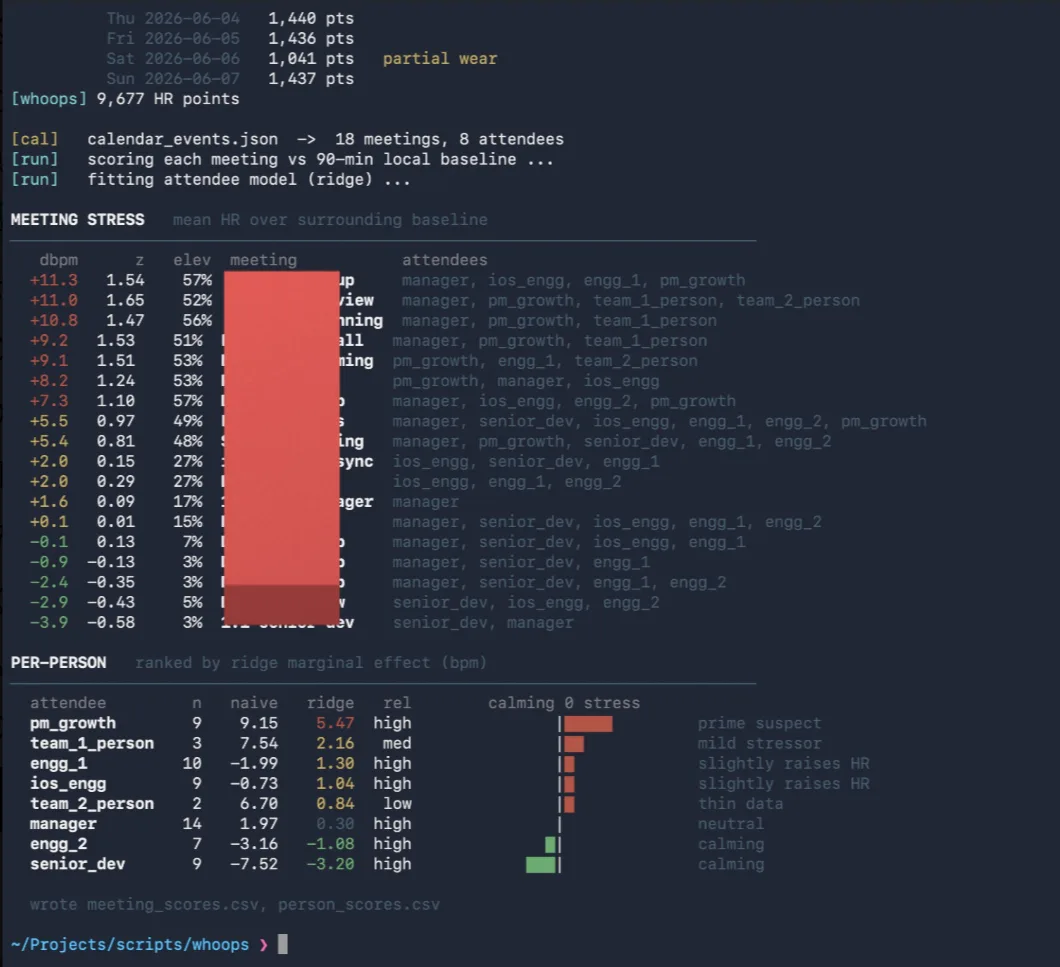
Set aside the leaderboard-of-people part for a moment, because that is the part to be careful with, and look at what the experiment really measured: the operating environment has a physiological cost, and that cost is uneven. A status update with no clear agenda spiked his heart rate. A focused working call did not. The environment we put people in is doing something measurable to them, all day, whether or not anyone is looking.
The CX dashboard measures one side of the conversation
Walk into any contact center and the instrumentation is impressive, on one side. We measure customer sentiment, CSAT, NPS, average handle time, first-contact resolution, repeat contacts, complaints, escalations, and QA scores. We can tell you how the customer felt to two decimal places.
We rarely ask the other question: how does the agent feel while serving the customer?
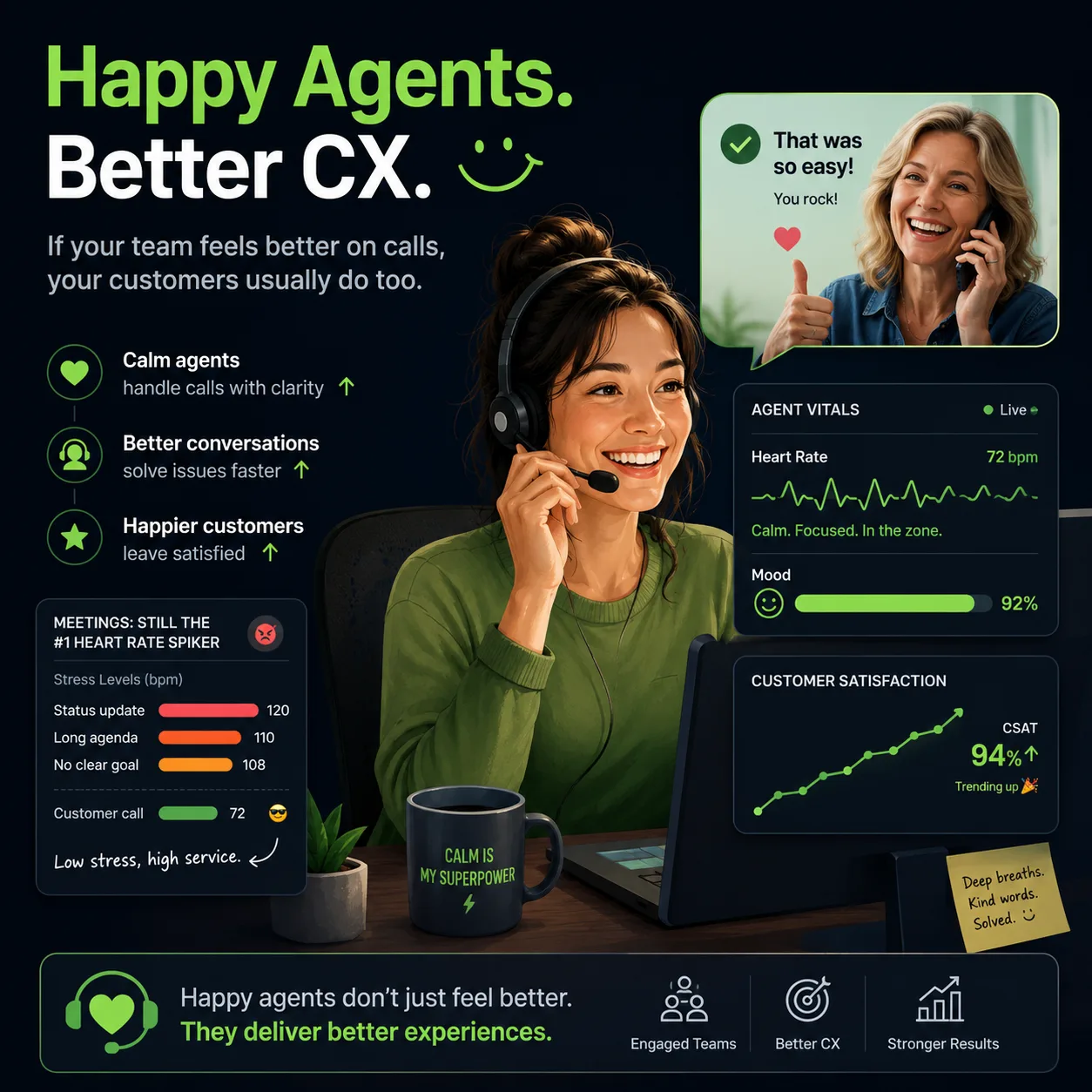
That question matters, because the answer leaks straight into the customer’s experience. A calm, confident, supported agent tends to have better conversations. A stressed agent rushes. A confused agent transfers. A disengaged agent follows the script perfectly and misses the emotion in the call. A settled agent listens better, solves better, and leaves the customer feeling better. Customer experience is not only what the customer feels. It is also what the employee feels while delivering it. Measure one half of that and you are flying with half an instrument panel.
This is not a soft observation. It is the same systems thinking that makes a good agentic project work: the engineer in the story did not buy a product, he built a small agent that joined two data sources nobody had thought to join, and the join revealed a pattern. The CX equivalent is sitting right there. We already have the agent’s schedule, queue assignments, call types, and after-call work. We have never connected them to how the work actually lands on the person doing it.
From a gag to an operating signal
So the constructive version. Imagine the next CX dashboard showed not only customer sentiment, but agent energy, focus, and stress patterns across call types, queues, products, processes, and yes, internal meetings. Not to catch anyone. To schedule the work better.
The hardest call types and the most complex queues could land in the windows where people tend to have the most focus, rather than in the late-afternoon trough. Status-heavy, no-agenda meetings could be kept out of those same windows, since they are exactly the low-value, high-drain events the heart-rate experiment kept flagging. Recovery could be protected on purpose instead of by accident. None of this requires knowing anything about a named individual. It requires knowing that “complex billing disputes at 4pm after back-to-back syncs” is a pattern worth fixing.
The single rule that keeps this honest: both wellbeing and performance have to rise together. If a change lifts the numbers while grinding people down, it has failed, even if the dashboard looks better this quarter. The goal is a calmer operating environment that also happens to handle calls better, because the two are the same thing. Choosing where to apply this first is the same discipline as choosing any first automation: pick something bounded, with a low blast radius if you get it wrong, and learn from it before you scale.
The ethics line: this is health data, treat it that way
Here is where the viral story stops being a template and starts being a warning. The thing that makes the original funny, one person measuring their own body on their own device, is exactly the thing that makes the management version dangerous. Heart rate, heart rate variability, sleep, mood, and recovery are health and biometric data. They are personal. Under privacy regimes like the GDPR they are special-category data with a high bar for any processing at all, and the ethics are stricter than the law: consent offered across the power gap between an employer and an employee is fragile, so it has to be genuinely optional, never a condition of the job, and never an input to anyone’s performance review.
That gives a short, firm set of guardrails:
- Voluntary, always. Opt-in, revocable, and free of consequence either way. Nobody wears a sensor to keep their job.
- Aggregate, never individual. The unit of analysis is the call type, the queue, the process, the meeting format. The output is “Tuesday-morning escalations run hot,” not a ranking of people. A leaderboard of coworkers is the line, and it is on the wrong side of it.
- Supportive, never punitive. The data exists to change schedules, agendas, and staffing, not to score, rank, or discipline a person.
- Minimal and purposeful. Collect the least that answers the question, for a stated purpose, and stop there. If you do not need biometric data to find the pattern, and usually you do not, do not collect it.
This is the same posture that responsible agentic systems already demand: bounded autonomy, a human in the loop, and a clear answer to “what is this allowed to do.” The engineering judgment for building agents that stay inside their guardrails, and for governing the data they touch, is the subject of Designing Enterprise Agentic AI Systems. The principle transfers cleanly from the agent to the workforce: measure to support the human, not to surveil them.
What to actually build first
You do not need wearables on your agents, and you should not start there. Start with the voluntary, low-sensitivity signals you can stand behind: a quick self-reported energy or mood check-in at the top of a shift, the schedule and queue data you already own, the agent’s own read on which call types drain them. Join those the way the experiment joined heart rate to the calendar, look for the patterns, and act on the operating environment, not on the people. The relationship between agent state and call quality is loud once you let yourself look at it, and most of what you find is fixable with scheduling, agendas, and staffing, no biometrics required.
The customer’s experience is, in part, the employee’s experience wearing a headset. We have spent a decade getting very good at measuring one of those and almost completely ignoring the other.
Happy agents, better CX. Simple idea, and hard to fake. Sometimes the biggest CX problem is not the customer. It is the operating environment we have built around the people serving them.
Frequently asked
Quick answers
- Should companies put heart-rate monitors on their customer service agents?
- No, not as a management tool, and that is the wrong place to start. Heart rate, heart rate variability, sleep, and recovery are health and biometric data. They are personal, they are sensitive, and in many jurisdictions they are legally special-category data that cannot be processed without explicit consent and a narrow purpose. The viral experiment that inspired this piece was one engineer measuring his own body, voluntarily, on his own device. That is a world away from an employer attaching monitors to staff and building a dashboard from the readings. If you want a sense of agent energy, begin with voluntary, low-sensitivity signals (a quick self-reported mood or energy check-in, schedule and queue data you already hold) and only ever in aggregate.
- What is agent experience and how is it different from customer experience?
- Customer experience is what the customer feels across an interaction: were they understood, was it easy, was it resolved. Agent experience is what the person delivering that interaction feels while doing it: are they calm or rushed, supported or stranded, focused or drained. The two are linked. A stressed agent rushes, a confused agent transfers, a disengaged agent follows the script but misses the emotion in the call. CX programs measure the customer side in detail (CSAT, NPS, AHT, FCR, escalations, QA) and rarely measure the agent side at all. Agent experience is the missing half of the same conversation.
- How can agent energy data improve CX without harming employees?
- By keeping it aggregate, voluntary, and never punitive. Use it to find patterns across call types, queues, products, processes, and meeting formats, not to rank individuals. Schedule the hardest work into the hours where people tend to have the most focus, keep low-value meetings out of those windows, and protect recovery. The test is simple: both wellbeing and performance should rise together. The moment the data is used to rank, score, or schedule against a named person, you have rebuilt the surveillance version and you should stop.
- Is biometric or mood data legal to use for workforce management?
- Treat it as restricted by default. Under regimes like the EU GDPR, health and biometric data are special-category data with a high bar for processing: explicit consent, a clear and narrow purpose, data minimization, and strong safeguards. Many other privacy frameworks treat it similarly. Beyond the legal floor there is an ethical one: consent given under the power imbalance of employment is fragile, so participation has to be genuinely optional and never a condition of the job or an input to performance review. When in doubt, do not collect it, and never collect it at the level of the individual.