
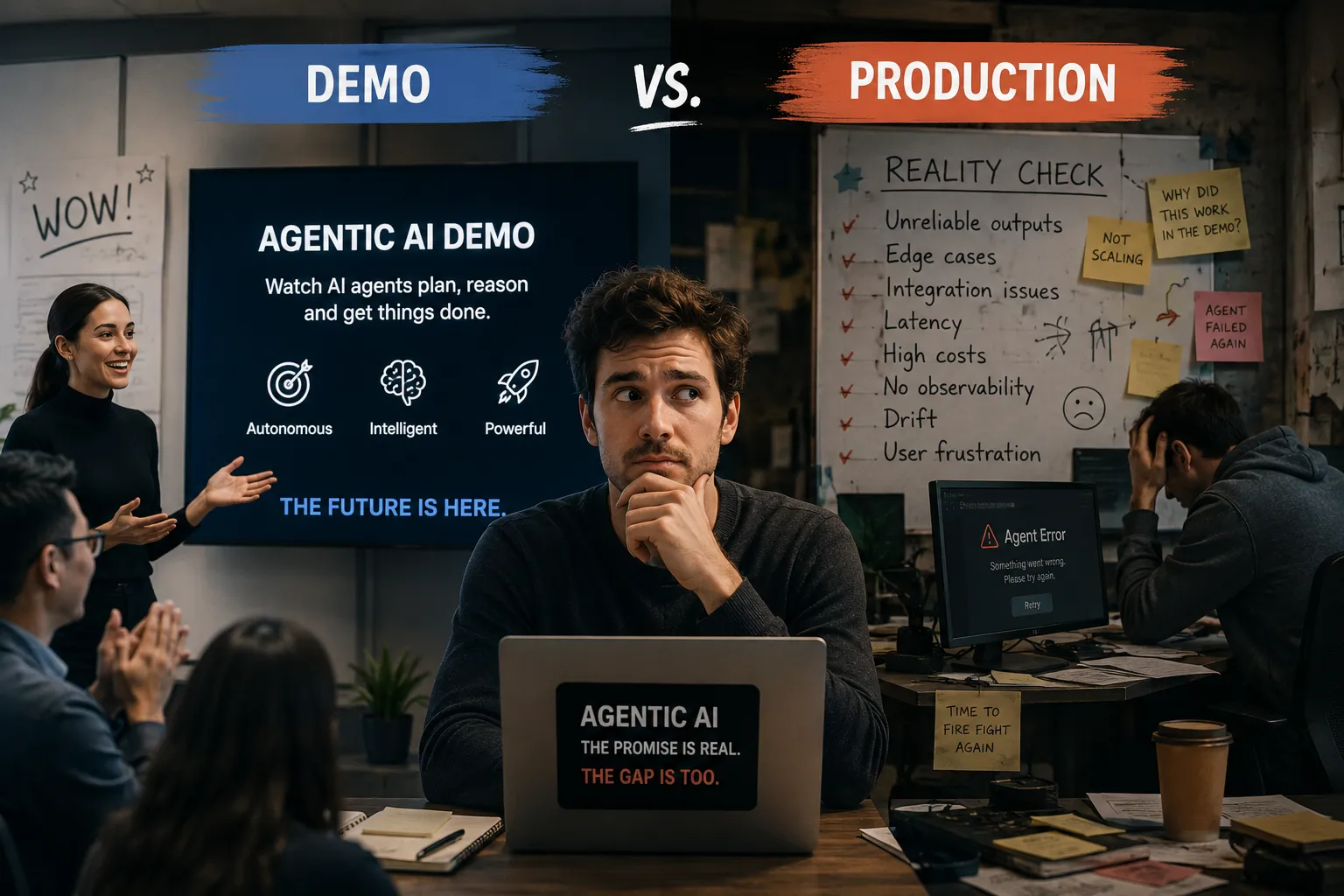
A demo proves an agent can do the task once. Production asks whether it can do the task ten thousand times, on input nobody curated, while a tool is timing out, inside a cost ceiling, for a user who is trying to make it misbehave, with no one watching. Those are not the same claim, and the second one is the hard one. The reason so many agentic AI pilots stall after a dazzling demo is not that the demo was fake. It is that a demo and a production system are built to answer different questions, and a convincing answer to the first tells you almost nothing about the second.
This is the gap I get asked about most often: the agent that wowed the room in March is still not live in June, and nobody can quite say why. The honest answer is that the demo was the easy 20 percent and everyone mistook it for the project. What follows is why the gap exists, the four gates a pilot has to pass that a demo never faces, and what that means for how you should read any agent demo, including your own.
A demo is the best case by construction
The thing to understand first is that the demo-to-production gap is not an accident or a sign of a sloppy build. It is created on purpose, because that is what a demo is for. A good demo is supposed to show the capability at its best. To do that, the person building it makes a series of reasonable choices that all point the same way: toward the happy path.
They pick the input. Not whatever a real user would type, but the request they know the agent handles well. They control the conditions. The tools are up, the network is fast, the data is clean, because the demo is running on a laptop in a quiet room, not against a flaky third-party API at peak load. They run it until it works. A demo is the take that went well, not the average of the takes. And they watch it. The builder is standing right there, ready to nudge, retry, or quietly skip the prompt that triggers the bad behavior.
None of that is dishonest. It is how every demo of everything has always worked. But notice what it adds up to: a demo is the agent’s performance with the four hardest properties of production removed. Curated input instead of real input. Controlled conditions instead of hostile ones. A single good run instead of repeated runs. A human supervisor instead of nobody. Production is the systematic re-introduction of all four at the same time, and the agent that cleared the demo has never met any of them.
That is why “but it worked when I showed you” is true and beside the point. It worked under conditions designed to make it work.
The four gates a pilot has to pass
Between the demo and a live system sit four gates. A pilot ships only when it clears all four. A demo clears none of them, not because it is bad, but because it is never asked. Each gate is a condition the demo was built to avoid.
Gate 1: reliability, not a single success
The demo showed one run that worked. Production runs the same task continuously, and the question changes from “can it” to “how often does it not.” This is where the non-deterministic nature of agents stops being a footnote and becomes the whole problem.
Deterministic software has a comforting property: if it passes a test once, it passes that test every time, because the same input produces the same output. An agent does not work that way. It is built on a model reasoning under uncertainty, so the same input can produce a different decision on the next run. The demo you saw was one sample from a distribution, and you were shown a good one. Maybe nine runs in ten succeed. At demo scale that looks like “it works.” At production scale, one in ten failing is a tenth of your users having a bad experience, every day, and the failures are not even the same failure twice. Closing this gate is the move from trusting the agent to bounding it, so that the runs that go wrong are caught and made cheap rather than assumed away. I have written more on the specific shapes those failures take in the failure modes a senior reviewer probes for.
Gate 2: messy inputs and broken tools
In the demo, the input was clean and the tools were up. In production, the input is whatever a real person sends: half a sentence, the wrong field, two requests at once, a typo in the one value that mattered, a question the agent was never meant to handle. And the tools the agent depends on will fail. An API will time out, a service will return an error or, worse, return something plausible but wrong, a database will be briefly unreachable.
A demo never tests what the agent does when its tools betray it, because in the demo they never do. But in production that is a daily event, and the agent’s response to a broken tool is often where the real damage happens: it retries forever, it invents a result, it proceeds as if the failed step succeeded. The agent that looked smart on a clean run can look reckless the first time the world hands it something it did not expect, and the world does that constantly.
Gate 3: a cost and latency budget
The demo ignored two numbers because it could afford to: how much the run cost and how long it took. One run on a laptop, nobody counting tokens, a few seconds of latency that read as “thinking.” Production cannot ignore either. Tokens are real money, and an agent that loops or over-reasons can turn a routine task into a surprising bill, multiplied across every user. Latency is real patience, and an answer that is correct but slow is a failure for anyone waiting on it.
A demo has no budget, so it never finds out that the agent’s average path is twice as expensive and three times as slow as the one you were shown. Production has a budget by definition, because someone is paying for the compute and someone is waiting for the result. The gate is whether the agent stays inside both ceilings on the average run, not the lucky one.
Gate 4: a safety boundary around real users
In the demo, the only user was the builder, and the builder wanted it to work. In production, the users are everyone, including the ones who are careless, the ones who are confused, and the ones who are actively trying to get the agent to do something it should not. An agent with real tools is a system that can take real actions, and the question production forces is: when it makes a wrong decision, or when someone talks it into one, how much damage can it do?
This is the gate where the stakes are highest, because it is about blast radius. A demo never asks what the worst action the agent can take actually costs, because in the demo it only ever takes the right one. Production has to assume the wrong one will happen and make sure it is survivable: write access kept narrow, irreversible actions gated behind a human, untrusted input never trusted with privileges. The demo proved the agent can act. This gate asks whether you can live with it acting wrongly.
The pattern behind all four
Read the four gates together and the same shape appears each time. A demo is the agent with the conditions of production stripped out. Reliability is stripped out by running it once. Messy inputs and broken tools are stripped out by curating the input and controlling the environment. The budget is stripped out by not counting. The safety question is stripped out by having one friendly user. Production is just those four conditions put back, all at once.
That is why the gap is structural and not a matter of polish. You are not fixing bugs in the demo. You are building the parts of the system that the demo was specifically designed not to need. That work, making it reliable, making it robust to bad input and broken tools, making it cheap and fast enough, making it safe, is the actual engineering of an agentic system. The demo was the hypothesis. The pilot is the experiment. Confusing the two is the single most expensive mistake I see teams make with agents, because it sets a timeline and a budget against the 20 percent and then acts surprised by the 80.
What to do with this
The practical takeaway is not pessimism. Agents are shipping real value in production right now. The takeaway is to stop treating the demo as evidence of readiness and start treating it as the beginning of the work.
Three things follow. First, choose a first use case where the four gates are gentle: high volume so you learn fast, bounded scope so the inputs are not infinite, and a low blast radius so the early mistakes are cheap. That is the same logic behind choosing what to automate first, and it matters more here than anywhere. Second, grade the failure paths, not the happy path. Run the agent on the inputs you would never choose, break its tools on purpose, measure the cost and latency of an average run, and find out what its worst action actually costs. If you have only ever watched it succeed, you do not yet know what you have. Third, budget for the gap in time and money, because the distance from a working demo to a shipped pilot is where the real engineering lives, and it is not free.
If you have a demo that impressed everyone and a pilot that will not quite ship, that distance is exactly the problem worth paying to close, and it is the work I help teams scope and de-risk through a readiness review. The deeper treatment of the controls, the architecture, and the failure handling that get an agent through all four gates is the subject of Designing Enterprise Agentic AI Systems.
A demo answers one question: can this agent do the task at all. It is a real question and a worthwhile yes. But it is not the question production asks. Production asks whether it does the task every time, on the worst input, with a tool down, inside a budget, for users who will not cooperate, when nobody is watching. The teams that ship agents are the ones who hear those as different questions from the start, and do the work the demo let them skip.
Frequently asked
Quick answers
- Why does an agentic AI demo work but the production version fail?
- Because a demo and a production system make different claims. A demo shows the agent can complete a task once, on input the builder chose, under conditions the builder controlled, with the builder watching. Production removes all four of those supports at the same time: the input is whatever real users send, the conditions include slow and broken tools, nobody is watching most runs, and the same task runs thousands of times. The agent that cleared the demo never had to survive any of that. The gap is not a bug you forgot to fix; it is the set of conditions the demo was built to avoid.
- What is the demo-to-production gap for AI agents?
- It is the distance between "the agent worked when I showed it" and "the agent works when I am not watching." It is created on purpose: a demo is curated to be the best case, so it hides variance, cost, edge cases, tool failures, and adversarial users. Closing the gap means re-introducing each of those conditions deliberately and proving the agent holds up, which is engineering work measured in weeks, not the afternoon it took to build the demo.
- How is a non-deterministic agent different from normal software in production?
- Normal software is deterministic: the same input produces the same output, so a test that passes once keeps passing. An agent is built on a model that reasons under uncertainty, so the same input can produce a different decision on the next run. That means "it worked in the demo" carries far less information than it does for traditional software, and the controls that matter shift from "did the code run" to "is the wrong decision cheap when it happens." You bound the agent rather than trusting it.
- What are the gates a pilot has to pass that a demo does not?
- Four. Reliability: it has to succeed not once but repeatably at the volume real usage brings. Messy inputs and broken tools: it has to handle malformed data, ambiguous requests, and tools that time out or return garbage. Budget: it has to stay inside a cost and latency ceiling, because tokens and seconds are now real money and real user patience. Safety: it has to operate inside a permission boundary so that a wrong decision, or a user trying to make it misbehave, has a small blast radius. A demo is never asked any of these questions.
- How do I tell if an agent pilot is actually ready for production?
- Stop grading the happy path and start grading the failure paths. Run it on messy and adversarial inputs, not the inputs you would choose. Break its tools on purpose and watch what it does. Measure the cost and latency of a real run, not a lucky one. Check what the worst wrong action it can take actually costs. If you have only watched it succeed, you have a demo, not a pilot. The readiness question is not "can it work" but "what happens on the runs where it does not."
- Does this mean agentic AI is not ready for production?
- No. It means the demo is the wrong evidence. Agents are shipping real value in production today, but the teams doing it treat the demo as the start of the work, not the proof that it is done. They budget for the gap, choose a first use case with a low blast radius, and engineer the reliability, the failure handling, the cost ceiling, and the safety boundary that the demo skipped. The technology is ready; the demo just does not tell you whether your system is.