
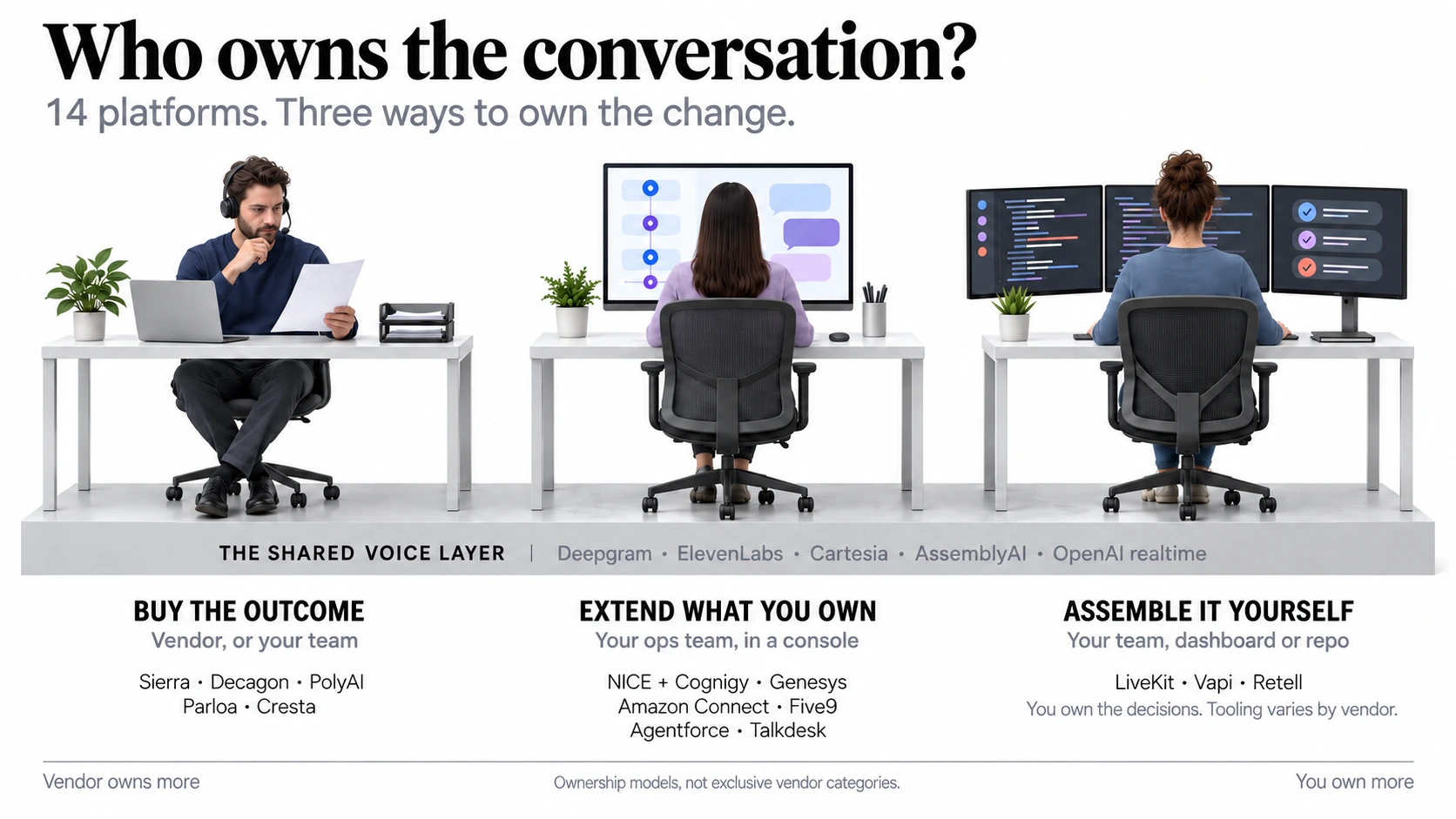
Most comparisons of voice AI platforms are feature grids. This one asks a different question, because the grids all converge and the thing that separates these products in practice sits outside them. Vendor claims here are checked against primary sources, and where I could not find something, this says that rather than claiming the vendor lacks it. This is a review of public evidence, so it can tell you what a vendor documents and what it stays quiet about. It cannot tell you which product performs best, and nothing here is a benchmark of one against another. This market moves fast enough that a shortlist has a shelf life, so check the date on this article before you act on any of it.
The Tuesday afternoon question
First, whose seat you are sitting in. You run customer operations, either the contact center inside a company or a BPO delivering it for clients, and you own the service levels and the vendor contracts. Engineers may build what you buy, but you are the one who answers for it.
It is Tuesday afternoon. Someone in finance has decided that refunds on one product line work differently now. Customers past their renewal date get store credit instead of money back. It starts next week, and nobody outside finance has heard about it yet. That is a small change, and it is the shape of almost every change you will make for the next three years.
So ask the question that sorts these platforms. Who makes that change, and how long does it take? There are four honest answers. Your vendor makes it and you file a request. Your operations team makes it in a console. Your engineers make it in a repository and ship it like any other code. Or nobody is quite sure, which is the answer more often than anyone admits.
What you are really choosing is who owns the conversation logic, and how much ceremony stands between a decision and a live call. Answer that and the shortlist gets short quickly. Leave it open and every vendor demo looks equally good, because every vendor demo is the launch and never the Tuesday.
Everything below is sorted by what you own rather than by who you buy from. That distinction matters more than it sounds, and I will come back to why.
If you want the ground underneath this, voice AI agents are harder than chatbots covers why the phone call breaks design decisions that were fine in chat, and from deflection to resolution covers why the contact center market moved in the first place. Neither is repeated here.
What to look for
Seven things. The first three are table stakes that every serious vendor now claims, and you should still test them yourself. The last four are where the products genuinely differ.
Turn-taking and barge-in. The caller talks over the agent, and the agent has to stop, immediately, and know what it had already said out loud. Every vendor claims this. Ask for a recording of a real caller interrupting mid-sentence.
Where the latency budget goes. Treat about a second as the design target for the first audible response, not a law. Only the work that blocks that first response comes out of the budget, usually speech recognition, reasoning and speech synthesis, plus any tool call the agent waits on before speaking. A slow lookup does not have to be one of those: the agent can acknowledge the request and keep talking while it works, and you measure that completion on its own clock. Ask which step they will cut when you add a lookup into a slow system of record, because you will.
Telephony as a first-class thing. SIP, transfer, hold, warm handoff with context attached. A voice agent that hands a caller to a human who then asks for the account number again has wasted everybody’s time.
Whether you can read what happened. Dashboards are easy. What you need is the actual decision path of a specific call that went wrong, on the day a customer complains about it.
What a change costs. The Tuesday question.
How you know the change is safe before it ships. This is the newest axis, most of the platforms here shipped something for it inside the last year, and it has a hole in it. Its own section, below.
How you are billed. Per agent seat, per minute, per session, per resolved issue. Each one bills you for something different, and one of them quietly punishes success. If you want that argument in full, what an AI agent actually costs per resolved customer issue works the numbers.
Notice what is missing from that list. Valuation, funding, headcount and logo walls. I have written about the money flooding this market and ranked the field by valuation for a different argument. None of it belongs in a buying decision, and a shortlist that leads with funding rounds is telling you who raised money rather than who ships.
The shortlist
Three routes, by what you own, plus the component layer they all sit on.
One caveat before the names, and it is a real one. The tiers describe what you own, and they say nothing about who you buy from. Several of these vendors reach buyers through more than one route. Cresta sells direct to enterprises and also through Five9, Genesys, NICE, AWS and Twilio, and says it has won Five9’s partner-of-the-year award in consecutive years. So a contact center already on Five9 may well end up buying Cresta through Five9. Any comparison that presents four tidy boxes is lying to you slightly.
Buy the outcome
You describe what should happen, the vendor owns how. Usually the shortest path to something working. The Tuesday change goes through the vendor, or increasingly through a builder they hand you, which is the part of this tier that has moved most in the last year: Cresta has Conductor, Parloa has Navigator, PolyAI has its development kit. Who edits, who approves and who deploys are three separate questions here, and the answers are contract terms rather than fixed properties of the tier.
Sierra is the one I would look at first if you want the buy-the-outcome route without giving up engineering discipline. Sierra describes an agent release as an immutable snapshot bundling the source, the prompts, the model version dependencies and the knowledge the agent can see, all in one numbered thing. Releases move QA to staging to production. Rollback is instant because the release is immutable. Since August 2026 there are merge approvals, so an organisation can require peer review before a change releases, the way a pull request does, and split-traffic rollouts, which is canary deployment under a different name. Both are controls you switch on rather than rules the platform enforces. Of the release documentation I read for this piece, that is the most complete, and the fact that it reads as unremarkable to an engineer is the point.
Decagon is the one to look at if the thing keeping you up is evaluation rather than release. Its versioning is Git-based with GitHub integration, isolated workspaces, diff review, rollback and audit logs. More on its evaluation below, where it earns the strongest position in this article.
It also carries an answer to the Tuesday question that the three routes above do not cover. On 9 September 2026 Decagon published an update on Autopilot’s production governance, where the agent proposes and makes its own improvements, and says Duet “is now performing more agent-building work than humans”. A reviewer sees a projected impact on deflection before accepting a change, and Decagon reports that 85 percent of accepted changes were still live 30 days later. A second track runs alongside it, where “trigger-based runs act on errors the instant an alert fires, without waiting for a review cycle”. Read that carefully: it says when the work starts, not what reaches production unreviewed.
PolyAI shipped Wren the same day. It also runs “daily, autonomously, against real conversations”, surfacing each change as a card you approve or dismiss. PolyAI says it “won’t ship a change without proof”, that a person makes the final call “when it matters most”, and that it will “always confirm with you before changing business logic or content”.
So the fifth answer to who makes the Tuesday change is that the platform makes it. Both vendors put a person somewhere in the loop, and neither says plainly where the loop closes: which changes can be generated, merged and deployed with nobody looking. That is the question to put to any vendor selling you a self-improving agent, in those words, along with which approval gates you can configure yourself.
PolyAI has, on paper, the most literal answer to the Tuesday question of anyone here, and its development kit is where it lives: “every agent resource is a versioned file that can be branched, diffed, reviewed, and merged exactly like application code, with full history and rollbacks included.” Its Agent Development Kit is a CLI and a Python package, so an engineer can build locally and push. If your organisation already runs on pull requests and you want the agent to live in that world, this is the closest fit on paper. Since September 2026 it also has Wren, a coding agent that runs daily against real conversations and proposes improvements, each one arriving as a card to approve or dismiss. Testing is an LLM judge scoring scenarios you describe in plain English, with more on that below.
Parloa takes the natural-language route. You describe the behaviour and the platform builds it, and its answer to the Tuesday question is Navigator, where a CX team uploads an existing procedure or describes the change in plain language and, in Parloa’s words, gets “a working update in minutes” without “having to outsource to engineering or IT”. Its guardrails follow the same principle, enforced “at the infrastructure layer, below the conversation, below the prompt”, with compliance and operations teams setting what each agent will engage with and “no engineering queue required”. Testing is serious and I will come to it. The gap is versioning. I found no environments, no rollback and no audit trail in the public sources I reviewed, and that is the question to take into a sales call.
Cresta takes the same route through Conductor, “a natural-language interface where they can explain, in plain language, what they want to build.” Its testing is the strongest part of the story and gets its own section below. It also shipped a command-line interface in August 2026 that treats revisions as first-class resources, validates “the exact revision under consideration” in CI/CD, and keeps promotion between environments “protected by permissions and approval gates”, though no diff, rollback or Git story was found in the public sources reviewed.
Extend what you already own
The tier nobody writes about, and the one most readers are actually in. If you are running a contact center today you are already paying a CCaaS vendor, and that vendor now sells an agent. The honest starting question is whether the one you are already paying for is good enough.
NICE CXone with Cognigy is the best documented of these, and NICE bought it rather than building it. It acquired Cognigy for around $955 million, closing September 2025. What you get is genuinely developer-grade. Snapshots are immutable versions of a project capturing fourteen resource types including the configured model, so a model change sits inside the versioned unit rather than floating underneath it. Read the exclusions before you rely on that, though: a snapshot does not include Endpoints or Knowledge AI, so the knowledge your agent answers from sits outside the versioned unit, and freezing a model configuration does not freeze the provider’s behaviour behind it. Documented development, staging and production environments. And an official command-line tool with clone, push, pull and diff, which means your agent config can live in Git alongside everything else.
Genesys Cloud has moved fast and is unusually open about its parts. It names its speech vendors publicly: Deepgram for real-time recognition, available now, and ElevenLabs text to speech expected in its fiscal third quarter, which ends 31 October 2026. It runs Scaled Cognition’s large action model, and it bought Pinkfish for tool integration. Genesys says Genesys Cloud is at nearly $2.9 billion in annual recurring revenue, growing more than 30 percent. It mentions new tools for building, testing and optimisation without detailing them. Its platform pricing is public, at $75, $115, $155 and $240 per named user per month billed annually, with AI features drawing on consumption tokens on top. Versioning is better served than I first credited: Architect keeps a version history with check-in dates, publication status, export and read-only access to older versions, and it flags which flows are Virtual Agent enabled. What I could not find is an equivalent story for the newer agentic pieces.
Amazon Connect took the same buy-it route. AWS acquired NLX in April 2026 and shipped the Agentic CX designer, a no-code canvas, in preview in June. It went generally available on 2 September 2026 across nine regions. Three things make it distinctive. The pricing is genuinely transparent, $0.038 per voice minute with AI features bundled into the channel rate, no seat licensing, no minimums, plus standard telephony charges on top and rates that vary by region. Live Sync keeps what the caller hears in step with what they see on a screen, which is the same idea NLX had shipped as Voice+. And the documentation is more forthcoming about the boring parts than most of this list, packaging changes “into builds” deployed “to the appropriate environment”, with testing and debugging before deployment, A/B tests after it, and “guardrails, roles, permissions, audit, and versioning” named as governance controls.
Salesforce Agentforce is the obvious answer if your service organisation already lives in Salesforce, and its testing story is stronger than most. Testing Center went generally available in May 2026 with custom scoring evaluations, multi-turn conversation testing with voice simulation, and run history. Versioning is real, with the agent compiling to a portable JSON file and Salesforce CLI and Agentforce DX for CI/CD. How many versions you can keep is a number to ask for rather than look up. The figure that circulates online describes Einstein Bots, which Salesforce documents as a different product from Agentforce, and I could not confirm an Agentforce limit in Salesforce’s own documentation. It is also one of the few here that publishes what it charges, though you will need a spreadsheet: Flex Credits at $500 per 100,000, an Agentforce action costing 20 credits and a voice action 30, which puts a voice action at fifteen cents, alongside $2 per conversation. The $125 per user per month add-on and the Agentforce 1 editions from $550 are employee-seat purchases, a different thing from the metered consumption that customer-facing voice runs on, so do not read a seat price as an unlimited customer agent.
Five9 launched a new release of its Voice AI Agents in June 2026 on what it calls an Agentic Voice Switch, claiming low-latency streaming, turn-taking, interruption detection and noise management. I want to be careful here, because trade coverage widely reports that Five9 runs Deepgram, ElevenLabs and OpenAI underneath. Neither Five9’s own June 2026 press release nor its product page names any third-party vendor at all, so I am not going to state it. The nuance is worth having, because Five9 has named suppliers before. A 2023 post says IVA Studio “provides access to Deepgram’s highly accurate speech recognition engine”, and names OpenAI and Google alongside it. What it stopped naming is what sits under the new architecture. So the checkable version is that Genesys tells you what is inside its current voice stack and Five9 used to, and that Five9 publishes seat pricing for its lower tiers, $119 for Digital and $159 for Core, while the tiers carrying the AI agents are quote-only. That is a transparency difference and nothing more. You can confirm both in an afternoon.
Talkdesk publishes seat pricing, and for a voice comparison the number that matters is Voice Essentials at $105 per user per month, not the $85 digital plan. Autopilot appears in the plan capability lists rather than as a priced add-on, which is not the same as unlimited usage being included, so confirm the entitlement and what happens past it. It ships Autopilot for voice self-service, which gained automatic language detection and end-of-speech sensitivity controls in March 2026.
Assemble it yourself
You own the loop, the vendor owns the pipes. The most control, and you have just hired yourself a product team.
LiveKit Agents is the serious open-source choice: a custom turn-detection model, full SIP telephony so a caller can join from a phone, Python and Node.js, and LiveKit Cloud for managed deployment with transcripts and traces. It is the transport layer under a lot of things you have used, and its pricing is the most itemised here alongside Vapi’s, with a published per-minute rate for each speech and language model you might pick. Its calculator prices one example configuration at $0.0100 a minute each for agent session, telephony and observability, but read that as one worked example rather than a rate card: real billing turns on plan allowances, on local calling against SIP, and on recordings and observability events. Versioning is yours, because it is your repository. Testing is better served than it used to be: the Agents documentation now ships a test framework that runs in pytest or Vitest, asserts on messages, tool calls and handoffs turn by turn, and carries an LLM-as-judge assertion, with end-to-end agent simulations against a simulated user still in beta. You still own the evaluation set and the criteria, which is the part that matters.
Vapi and Retell are where I would start if the goal is a working phone agent this week. Both publish itemised pricing, which makes them unusual here. Vapi charges $0.05 a minute for hosting and passes every component through at cost, listing the actual rates for speech to text, the model, speech synthesis and telephony. Retell advertises $0.07 to $0.31 a minute depending on the features and model you pick, with no fixed subscription fee and twenty concurrent calls included. Read that as an advertised range rather than a ceiling: its own rate card lists GPT Realtime at $0.345 a minute, and other charges apply on top.
Both also ship more release machinery than the tier name suggests, which is the thing I had wrong when I first wrote this. Vapi documents assistant versioning with published versions, a diff view, full history, restore and JSON export, plus Evals and Simulations and DEV, UAT and PROD environments. Retell documents immutable published versions, drafts branched from any earlier version, and environment tags you attach to phone numbers. You still own the evaluation set, the coverage and the decision to ship. You do not have to build the version control.
Retell also does something I have not seen another vendor say out loud: testing bills at production rates. “There’s no separate test tier and no free testing sandbox, so a message or a minute spent testing costs what it would on a live call.” That is honest, slightly unwelcome, and a useful thing to know before you plan a thousand-call regression suite.
The component layer
Deepgram and AssemblyAI for speech to text, ElevenLabs and Cartesia for speech synthesis, OpenAI’s realtime models. I have left these unranked, because you will end up using some of them whichever tier you choose, and several tiers above are reselling them to you. The cleanest public view of what this layer actually costs is Vapi’s own pass-through table, which lists its suppliers’ rates because it does not mark them up.
Who writes the answer key
Here is the newest axis, and the one I would push hardest on.
Most of the platforms here now sell automated agent testing. NiCE Cognigy shipped Simulator in January 2026, an “AI performance lab” running thousands of synthetic conversations, scoring each against “task completion, guardrail adherence, integration reliability, and experience quality.” Cresta shipped Automated AI Agent Testing in September 2025 with LLM judges, simulated visitors drawn from real conversations, and regression testing, then Testing 2.0 and Synthetic Customers in June 2026. Parloa scores simulated conversations with a mix of LLM-based and rule-based criteria and traces failures to line-level fixes. Salesforce has Testing Center. The category converged on the same answer in a little over a year.
Most of them lean on a language model acting as a judge, though the better ones mix it with deterministic checks: Cresta pairs language-model evaluators with “deterministic evaluators for criteria that can be checked precisely”, and Vapi supports exact matching and patterns alongside AI judges. Wherever a model is doing the grading, one question decides whether any of it is worth anything. Who writes the rubric that judge scores against, and how do you know the rubric is right?
I have a personal stake in this one. I once had an evaluation tell me my retriever was finding the right evidence for about one question in sixteen. I nearly rewrote it. Then I read the failures by hand and found the passages on screen answered the questions perfectly well, and it was my answer key that was wrong, because it named one correct page per question when several pages answered just as well. Scored fairly, the same run came out around half. Nothing in the system had improved. No score tells you that your answer key is wrong.
So I went looking for what each vendor says about theirs.
Decagon says the most, and it is the reason it ranks where it does. It audits a subset of its judge’s scores with human labellers, specifically “to further validate the LLM-as-judge scoring”, and it benchmarks against “a curated collection of user queries with ideal responses, labeled by human experts.” That is an answer key, described, with humans checking the machine that grades it. It still does not say who writes the rubric itself, so it goes far rather than all the way.
Autopilot is what makes that stop being an academic question. If the agent improves itself based on what the judge scores, the rubric is no longer just grading the work, it is steering it. Decagon says it checks that judge against “human-labeled ground truth and real production outcomes” and puts its accuracy at 99.5 percent, which is the right thing to measure. It is also a number I would want to see recomputed on my own conversations, because a judge that is accurate on a vendor’s benchmark is not yet accurate on my refund policy.
Sierra answers it differently, by publishing. It released tau-bench, and then hyper-tau-bench in September 2026, both open-sourced with public code and a public leaderboard. That is the method on the table where anyone can argue with it. It is worth separating that from publishing results, which several vendors do. Decagon reports DuetBench-2 scores, and I found no public code or leaderboard behind them, so you can read the number but you cannot run the test.
Cresta answers it too, and the answer is in the engineering blog rather than the launch announcement. Requirements are drafted from your own documentation, with a checker that flags “unverifiable language, multi-parameter criteria the LLM can’t grade reliably, and requirements that depend on context the agent doesn’t have access to”. Then, in Cresta’s words, “Domain experts then review, refine, and approve”, and each approved requirement becomes one evaluator running against both test conversations and production traffic. Evaluator Calibration then scores the evaluator itself. You review how it labelled a sample, correct it where it was wrong, and get an accuracy figure per requirement. An earlier post puts it plainly, “Manual review and annotation remain core to our process.”
Decagon and Cresta are giving different answers there, and the difference is worth seeing. Decagon audits its own judge and publishes that it does. Cresta hands you a number for how accurate an evaluator is on your own conversations. The first asks you to trust the vendor’s checking, the second lets you do your own. Both stop short of telling you the rubric is right, because no vendor can.
Cognigy and PolyAI both hand you the criteria and stop there. Cognigy scores runs against “configurable criteria” and invites you to tailor your own scenarios. PolyAI has you define scenarios in plain English and then, in its words, “the LLM acts as a judge to evaluate every outcome automatically”. Both put the rubric in your hands, which is the right place for it. Neither says how you would know the judge is reading your rubric the way you meant it, which is the part I have been burned by. That is an absence in the documents and nothing more, and Cresta is the reason to treat it that way, because the answer there sat in an engineering blog and not in the press release. But if you are buying a product whose job is to tell you your agent is safe to ship, the provenance of its grading standard is a fair thing to ask for in writing, and the answer should not be “the model figures it out.”
The number that should shape your plan
The most useful thing I found while researching this comes from Sierra, which is a vendor on this list. Worth holding that in mind while you read it.
Sierra’s hyper-tau-bench makes building an agent the task. A developer agent is handed what a real engagement hands you: the records a business actually keeps, a client who holds the requirements, a production API, a codebase to inherit, and limits on cost and models. Then it has to deliver a working customer service agent, scored by deploying it against held-out simulated users.
Across 53 tasks, the strongest configuration, Claude Opus 5 running under Claude Code, passed 23.9 percent of the evaluation simulations. The expert-authored reference ceiling scored 82.2 percent.
Read the failure modes, because they will surprise you. The models “issue shallow queries in place of deep comprehension of the records, communicate almost nothing to the client, and experiment too little with agent architecture and serving spend, shipping the first design that runs.”
Every one of those is a process failure, and the paper says as much: “the failures mirror ones human agent developers see”. Shallow understanding of the business records, no conversation with the client, no exploration before committing. Those are the things a good forward deployed engineer does, and they are exactly what goes missing when a tool builds the agent on its own.
Which is worth holding next to what the vendors are shipping. Cresta hires forward deployed engineers, and it also sells Conductor to let your business team build agents in plain language without one. Both things are true at once, and I think they sit together fine. The tool takes the routine changes, which is genuinely valuable and is most Tuesdays. The hard ones stay exactly where they were.
Where I am biased
I build these systems for a living. That means I make money when you land in the assemble-it-yourself tier and need help, and I make nothing when you decide your existing CCaaS vendor is good enough.
So take this with the appropriate discount. If you are a mid-size contact center with a healthy existing platform, look at what you are already paying for first. That has little to do with which product is better. Often the incumbent is worse. It is that the integration work you have already done is the expensive part, and a specialist agent that cannot reach your systems of record is a very articulate way to fail. The teams that struggle are usually the ones who chose a platform that could not reach the data.
The place that reasoning breaks down is when you can name something specific your current vendor cannot do, and it costs you real money every month. Then go looking.
Where each one is the wrong choice
Buy the outcome is wrong when your conversation logic is your competitive advantage, or when you cannot get a change made in a week and your business changes faster than that.
Extend what you own is wrong when your existing platform’s agent is a rebadged bot with a language model glued to the front. Test it against a genuinely messy call before you believe the roadmap.
Assemble it yourself is wrong far more often than engineers want to hear. You are taking on turn-taking, barge-in, telephony edge cases, evaluation, on-call and the entire release process, which is roughly the table of contents of Designing Enterprise Agentic AI Systems. LiveKit is excellent and ships the mechanisms, turn detection and interruption handling included. What stays yours is configuring them for your traffic, integrating them, validating them and running them. Do this when the agent is the product itself, and stay away when it is the support queue.
Any of them is wrong if you cannot say what a good call looks like precisely enough for someone else to grade one. That is a readiness question rather than a platform question, and there is a checklist for it.
| Platform | Who makes the Tuesday change | Versioning | Testing | Pricing |
|---|---|---|---|---|
| Sierra | Vendor, or your engineers via the Agent SDK | Immutable numbered releases carrying prompts, model versions and knowledge; merge approval; canary; instant rollback | Checks and simulations, plus open-sourced public benchmarks | Outcome-based model published, charged per resolution with no charge "in most cases" for unresolved or escalated conversations. No rates published |
| Decagon | Vendor, your team in console and GitHub, or the agent itself via Autopilot | Git-based, workspaces, diff review, rollback, audit logs | LLM judge, audited by human labellers, human-labelled ground truth, then online A/B | No rates published. Its AWS Marketplace listing is private-offer only |
| PolyAI | Your team in Agent Studio, engineers via the ADK, or Wren proposing changes you approve | Every resource a versioned file: branch, diff, review, merge, rollback | Scenarios generated from the agent's own flows, knowledge and tools, scored by a language-model judge | Per-minute model published, including maintenance and support. No rates |
| Parloa | Your CX team via Navigator, in natural language | Not verified in the public sources reviewed | Simulated conversations, LLM plus rule-based scoring, line-level fixes | No rates found in the public sources reviewed |
| Cresta | Your team via Conductor, or engineers via the CLI | Revisions promoted between environments behind approval gates, validated in CI/CD; no diff, rollback or Git story | LLM evaluators approved and calibrated by domain experts, accuracy score per evaluator, simulated customers, regression | No rates found in the public sources reviewed |
| NICE CXone with Cognigy | Your team in console, or engineers via the CLI | Immutable snapshots of fourteen resource types including the model; dev, staging, production | Simulator: synthetic conversations, API error simulation, A/B variants | $110 to $249 per agent per month, plus $0.25 per session on the top tier |
| Genesys Cloud | Your team in AI Studio | Architect version history, check-in dates, publish and unpublish, export, read-only older versions. No equivalent found in the public sources reviewed for the newer agentic pieces | Mentioned, not detailed | $75 to $240 per named user per month billed annually, plus AI consumption tokens |
| Amazon Connect with NLX | Your team, on a no-code canvas | Changes packaged into builds and deployed to an environment; audit and versioning named as governance controls | Test and debug before deployment, A/B tests after | $0.038 per voice minute, AI bundled, no seat licensing. Standard telephony charged on top, and rates vary by region |
| Five9 | Your team, in the platform | Not verified in the public sources reviewed | Not verified in the public sources reviewed | $119 Digital and $159 Core per seat per month. Tiers carrying the AI agents are quote only |
| Salesforce Agentforce | Your team in Studio, or engineers via CLI and DX | Portable JSON, with Salesforce CLI and Agentforce DX. No version cap confirmed in Salesforce's own docs | Testing Center: custom scoring evals, multi-turn voice simulation, run history | Flex Credits at $500 per 100,000; an action is 20 credits, a voice action 30. Also $2 per conversation, and an employee-facing add-on at $125 per user per month |
| Talkdesk | Your team, in Autopilot | Not verified in the public sources reviewed | Not verified in the public sources reviewed | Voice Essentials $105 per user per month, digital-only from $85. Autopilot entitlement and usage limits need confirming |
| LiveKit Agents | Your engineers, in your repository | Yours | Test framework in pytest or Vitest with an LLM-as-judge assertion, simulations in beta. Cloud adds transcripts and traces | Published per-model rate card for speech and LLM. Its calculator prices one example at $0.0100 a minute each for agent session, telephony and observability; real billing turns on plan allowances, local calling against SIP, and recorded events |
| Vapi | Your team in the dashboard or API, engineers where needed | Published versions, diff view, full history, restore, JSON export; DEV, UAT and PROD environments | Evals and Simulations, with exact match, patterns and language-model judges | $0.05 per minute hosting, components passed through at cost |
| Retell | Your team in the dashboard or API, engineers where needed | Immutable published versions, drafts branched from any earlier version, environment tags attached to phone numbers | Playground, simulation and batch, billed at production rates | Advertised $0.07 to $0.31 per minute by features and model, though the rate card lists GPT Realtime above that at $0.345. No fixed subscription fee, twenty concurrent calls included |
What I would actually do
Start from what you already own, and move only when you can name something specific it fails at. That is one decision rule and it is the only one in this article.
Then, concretely. Write down the Tuesday change, the real one from your own business, before you see a single demo. Take it to every vendor and ask who makes it, how long it takes, and how they would know it was safe. Ask who writes the rubric their testing scores against. Ask for a recording of an interruption. Ask what happens when the system of record is slow.
Transparency varies by layer rather than by vendor. Roughly half publish a plan or seat price you can read without a sales call, fewer publish what the agent consumes on top of it, and almost none put a number on the total cost of a deployment. When you get quoted, ask what the unit is and what happens to your bill when the agent gets better at its job.
If the answers come back thin and the work genuinely matters, that is usually the moment to get someone in who has done it before, which is what I do. And if your existing vendor answers all of it well, use them, and spend the money you saved on the integration work that will actually decide this.
Frequently asked
Quick answers
- What is the difference between an IVR and an IVA?
- An IVR routes a caller through options defined in advance, and a good one already does real self-service: balances, order status, payments. What it asks of the caller is that they navigate the tree. An IVA, or intelligent virtual agent, understands the request in natural language and reaches into the systems where the answer lives, so the caller can say what they want instead of choosing from a menu. The workflow behind it may be predefined, chosen dynamically, or planned by the agent, depending on the implementation; that is a design decision, not what makes it an IVA. When you evaluate either one, judge it on whether the issue was actually resolved and how much effort it cost the customer, rather than on how many calls it kept away from an agent.
- Should I use my contact center vendor AI agent or buy a specialist platform?
- Start with the one you already pay for and give it a real chance. The integrations you have already built are usually the expensive part, and the teams that struggle most are usually the ones who picked a platform that could not reach their data. Go looking elsewhere when you can name something specific your current vendor cannot do that is costing you real money every month.
- How are voice AI platforms priced?
- Four different ways, and each one bills you for something different. Per agent seat per month, which is what most contact center platforms charge. Per minute, which is what the developer toolkits charge. Per session, which some vendors add on top of seats. And per resolved issue, which a few specialists prefer. Transparency varies by layer. Roughly half publish a plan or seat price you can read without a sales call, fewer publish what the agent consumes on top of it, and almost none put a number on a whole deployment. Those are three different questions and vendors answer them very differently. Ask what the unit is, and ask what happens to your bill when the agent gets better at its job.